
When you’re running an air separation unit (ASU), you have two basic choices for moving around liquid oxygen (LOX), liquid nitrogen (LIN), and liquid argon (LAR): conventional cryogenic piping or vacuum jacketed piping. And honestly, while both can get the job done, they behave pretty differently once you look at their thermal performance.
These liquids come out of separation and storage at seriously cold temperatures—about −196°C for LIN, −186°C for LAR, and −183°C for LOX. It doesn’t take much external heat sneaking in before you start to get flash gas, which leads to product losses and messes with downstream pressure and flow stability.
Standard cryogenic pipe depends on some external insulation to keep things cool. But vacuum insulated pipe? That takes insulation up a notch. It uses a double-wall setup, with a high-vacuum space and several layers of insulation to cut down on heat transfer as much as possible.
At HL Cryogenics, we look at a bunch of factors before choosing the right pipe: line length, what fluid you’re dealing with, operating pressure and flow rate, how much heat leak you can tolerate, installation conditions, how often you run the system, and what you need over the long haul.
If you’ve got a liquid distribution system that runs nonstop, vacuum jacketed piping usually works better for the long haul. It’s more efficient and stable, especially if you really want to cut down on boil-off and keep the liquid phase steady at the downstream equipment.

Phase Separator

Vacuum Insulated Pipe

Vacuum Insulated Flexible Hose

Vacuum Insulated Shut-off Valve
Table of Contents
1. Advanced Thermal Insulation
2. Active Vacuum Management
3. Precision Flow & Phase Control
4. Flexible Systems & Compliance
● Advanced Thermal Insulation
Here’s what really separates these two systems: it comes down to how they manage heat transfer—conduction, convection, and radiation. Regular insulated cryogenic piping usually relies on materials like polyurethane foam or cellular glass wrapped around the outside. How well this setup actually works depends on a bunch of factors: insulation thickness, how airtight the vapor barrier is, the quality of installation, local humidity, and whether the insulation can resist moisture over time.
Vacuum Insulated Pipe, on the other hand, is a different animal. You’ve got an inner stainless-steel pipe that carries the cryogenic liquid, surrounded by an outer jacket. Between them, there’s an evacuated space, and that vacuum pretty much stops most conduction and convection. To deal with radiation, you add multiple layers of insulation inside the vacuum jacket. The internal supports are specifically engineered to minimize the heat conducted through the structure, and they can handle the pipe shrinking as it gets cooled down to something like –196°C.
All these measures add up: with less heat leaking into the system, you end up with less flash gas, fewer losses from venting, faster settling times, and a steadier flow of cryogenic liquid. Still, you can’t put a one-size-fits-all number on the thermal efficiency—you have to crunch the numbers for each system. Look at pipe diameter, length, what liquid’s inside, pressure, flow rate, how long and often the pipe operates, the surrounding environment, support type, and the insulation setup. In air separation units, even small amounts of heat leak matter once you account for the vast network of piping for LIN, LOX, or LAR. Over hundreds of meters, those leaks really add up.
● Active Vacuum Management
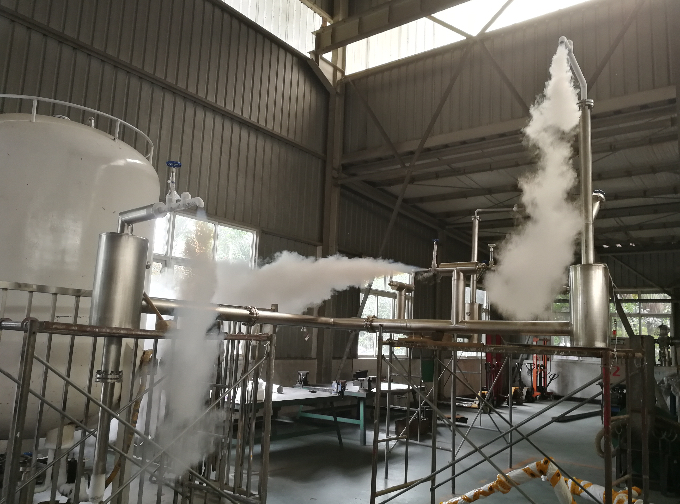
Long-term vacuum insulation really matters. The vacuum jacket only works as long as we keep the right vacuum level, so everything—manufacturing quality, welding, leak testing, surface prep, vacuum barriers, pump-out ports, and field connections—has to be spot-on. Lots of things mess with vacuum quality over time: outgassing from inside surfaces, tiny leaks, contamination, seals wearing out, temperature changes, or even damage during installation.
When you're dealing with big or mission-critical setups, we hook up our Dynamic Vacuum Pump System. This system connects the cryogenic transfer system’s vacuum spaces to pumping gear, keeping the vacuum where it needs to be or getting it back on track during maintenance. The same thinking goes for every component.
Take a Vacuum Insulated Valve—it keeps thermal protection around isolation and control points, so they don’t become weak spots. Then there’s the Vacuum Insulated Flexible Hose, or cryogenic hose. It handles vibration, equipment movement, installation quirks, and crazy routing while still minimizing heat leaks. And when you can’t avoid vapor formation, a Vacuum Insulated Phase Separator pulls the gas out of the liquid stream for steadier liquid conditions downstream. If you need localized storage or process buffering, we can build in a Mini Tank.
Bottom line: we look at the entire cryogenic transfer system as one integrated setup—thermal, hydraulic, mechanical, and vacuum all working together.
● Operational Safety
Mechanical design matters just as much as anything else with ASU piping. These pipes have to handle internal pressure, thermal contraction, sudden pressure swings, installation loads, and nonstop operating cycles. It’s not as simple as picking one pressure rating for all Vacuum Insulated Pipe or Vacuum Insulated Flexible Hose setups—each project needs its own evaluation.
At HL Cryogenics, we don’t cut corners. We go through everything: design and operating pressure, temperature, what’s inside the pipe, pipe diameter, how fast you need flow, pressure drop, thermal expansion and contraction, support layout, connection type, relief requirements, welding procedures, inspection, and testing. Only after looking at all these details do we decide what works best.
We rely on austenitic stainless steels, since these keep their toughness even at extremely low temperatures and also resist corrosion while staying weldable. Getting the welds right is critical. The inner process pipe needs to stay pressure-tight, and the outer jacket has to keep the vacuum intact.
Depending on the job, we run pressure tests, helium mass-spectrometer leak checks, vacuum tests, cleaning, prepping for oxygen service, and trace all materials. Plus, we make sure inspection documents are solid. HL Cryogenics holds ASME, CE, and ISO certifications, so we can manufacture and document products for projects worldwide—no matter the requirements. We follow ASME, EN, ISO, PED, and any customer-specific specs.
This matters a lot, especially for LNG infrastructure in Southeast Asia, semiconductor facilities in East Asia, industrial gas plants in Europe, and hydrogen projects in the Middle East. Engineering codes, documentation requirements, connection standards, and acceptance criteria can change quite a bit from one region to another. We’re ready to handle it.

● Precision Flow & Phase Control
Let’s walk through a real-world scenario: Imagine an ASU that needs to deliver liquid nitrogen from storage tanks to several production areas, loading zones, and process lines. If you use regular insulated cryogenic pipe, every single meter—plus every valve, elbow, joint, and exposed part—adds to the heat that sneaks in. That becomes a problem, especially when the pipeline sits idle for hours. More gas builds up inside, so before you can get liquid flowing again, you’ve got to vent or push out that excess vapor.
Here’s where smart engineering pays off. Instead of sticking with basic pipe, you can build a system using Vacuum Insulated Pipe for the main lines. For spots that need flexibility or movement, swap in Vacuum Insulated Flexible Hoses. Put Vacuum Insulated Valves wherever you need isolation, and add a Vacuum Insulated Phase Separator if phase control is important. If your setup calls for long-term vacuum management, go with a Dynamic Vacuum Pump System. For equipment that stops and starts, a Mini Tank offers local storage and buffering.
This isn’t just a fix for ASUs. You see these systems in liquid nitrogen setups, LNG plants, semiconductor factories, aerospace testing sites, food freezing lines, pharmaceutical production, hydrogen projects—the list goes on. Here’s the kicker: Picking conventional piping just because it’s cheaper up front doesn’t tell the whole story. EPC contractors and plant teams need to take a hard look at heat loss, wasted product, cooldown and restart times, pressure and phase stability, maintenance, installation headaches, vacuum reliability, and the total cost over the system’s life.
If you’re working on a custom ASU or any cryogenic transfer system, HL Cryogenics will dig into your P&ID, isometric drawings, fluid specs, pressure, flow rates, pipe sizing, operating strategy, and the relevant engineering standards. Then they'll build a vacuum-insulated solution that fits your actual project needs.
● FAQS
Since 1992, HL Cryogenics has specialized in the design and manufacturing of high-vacuum insulated cryogenic piping systems and related support equipment, tailored to meet diverse customer needs. We hold ASME, CE, and ISO 9001 certifications, and have provided products and services to many well-known international enterprises. Our team is sincere, responsible, and committed to excellence in every project we undertake.
Vacuum Insulated/Jacketed Pipe
Vacuum Insulated/Jacketed Flexible Hose
Phase Separator / Vapor Vent
Vacuum Insulated (Pneumatic) Shut-off Valve
Vacuum Insulated Check Valve
Vacuum Insulated Regulating Valve
Vacuum Insulated Connectors for Cold Boxes & Containers
MBE Liquid Nitrogen Cooling Systems
Other cryogenic support equipment related to VI piping — including but not limited to safety relief valve groups, liquid level gauges, thermometers, pressure gauges, vacuum gauges, and electric control boxes.
We are happy to accommodate orders of any size — from single units to large-scale projects.
HL Cryogenics' Vacuum Insulated Pipe (VIP) is manufactured in accordance with the ASME B31.3 Pressure Piping Code as our standard.
HL Cryogenics is a specialized vacuum equipment manufacturer, sourcing all raw materials exclusively from qualified suppliers. We can procure materials that meet specific standards and requirements as requested by customers. Our typical material selection includes ASTM/ASME 300 Stainless Steel with surface treatments such as acid pickling, mechanical polishing, bright annealing, and electro polishing.
The size and design pressure of the inner pipe are determined according to the customer's requirements. The size of the outer pipe follows HL Cryogenics' standard specifications, unless otherwise specified by the customer.
Compared with conventional piping insulation, the static vacuum system provides superior thermal insulation, reducing gasification losses for customers. It is also more cost-effective than a dynamic VI system, lowering the initial investment required for projects.
● Related Posts



Post time: Sep-22-2026


