
For most cryogenic projects, Vacuum Insulated Pipe carries a higher initial purchase price than conventional foam, perlite, or other external insulation systems, but the lifecycle cost can be lower when thermal losses, maintenance, reliability, and process stability are included. At HL Cryogenics, we therefore compare insulation systems on total installed and operating cost rather than on pipe price alone. In a cryogenic transfer system, heat enters through solid conduction, thermal radiation, and residual-gas conduction. Conventional insulation reduces heat ingress mainly by increasing the thermal resistance between the cold pipe and ambient air, but its performance can deteriorate if moisture enters the insulation, vapor barriers are damaged, or the system is repeatedly exposed to temperature cycling. A Vacuum Insulated Pipe uses an evacuated annular space, multilayer insulation, and engineered low-conductivity supports to suppress the major heat-transfer paths more effectively. This difference matters because every watt of heat entering a liquid nitrogen system, LNG line, or other cryogenic pipe contributes to boil-off, flashing, cooldown demand, and pressure changes. The lowest-cost solution at procurement is therefore not always the lowest-cost solution over the operating life of the installation.

Phase Separator

Vacuum Insulated Pipe

Vacuum Insulated Flexible Hose

Vacuum Insulated Shut-off Valve
Table of Contents
1. Heat Leak, Vacuum Stability, and the Operating Cost of Cryogenic Piping
2. Installed Cost: Pipework, Valves, Flexible Sections, and System Integration
3. Where Vacuum Insulated Pipe Usually Delivers the Strongest Economic Value
4. Procurement Decisions Should Be Based on Lifecycle Cost, Not Pipe Price Alone
● Heat Leak, Vacuum Stability, and the Operating Cost of Cryogenic Piping
The strongest economic argument for Vacuum Insulated Pipe is usually heat leak reduction, but the actual benefit depends on service temperature, pipe diameter, operating duty, line length, flow pattern, and how often the system is cooled down. A cryogenic pipe carrying LN2 at approximately -196°C has a temperature difference of more than 200 K relative to many ambient environments, so even modest insulation degradation can increase vapor generation substantially over long runs. In a conventional insulated line, wet insulation, damaged cladding, poor joints, and thermal bridges can gradually reduce thermal efficiency. In a vacuum-insulated system, performance depends instead on vacuum insulation performance, multilayer insulation quality, support design, joint configuration, and long-term vacuum stability. We design our systems so the inner process pipe, outer jacket, supports, bayonets, welded joints, and vacuum chambers work as one thermal structure. Where appropriate, a Dynamic Vacuum Pump System can be integrated into larger networks to support monitoring and maintenance of selected vacuum spaces. This is particularly relevant for extensive LNG infrastructure, semiconductor facilities, and industrial gas applications where access after commissioning may be difficult and thermal deterioration can become expensive to diagnose.
● Installed Cost: Pipework, Valves, Flexible Sections, and System Integration
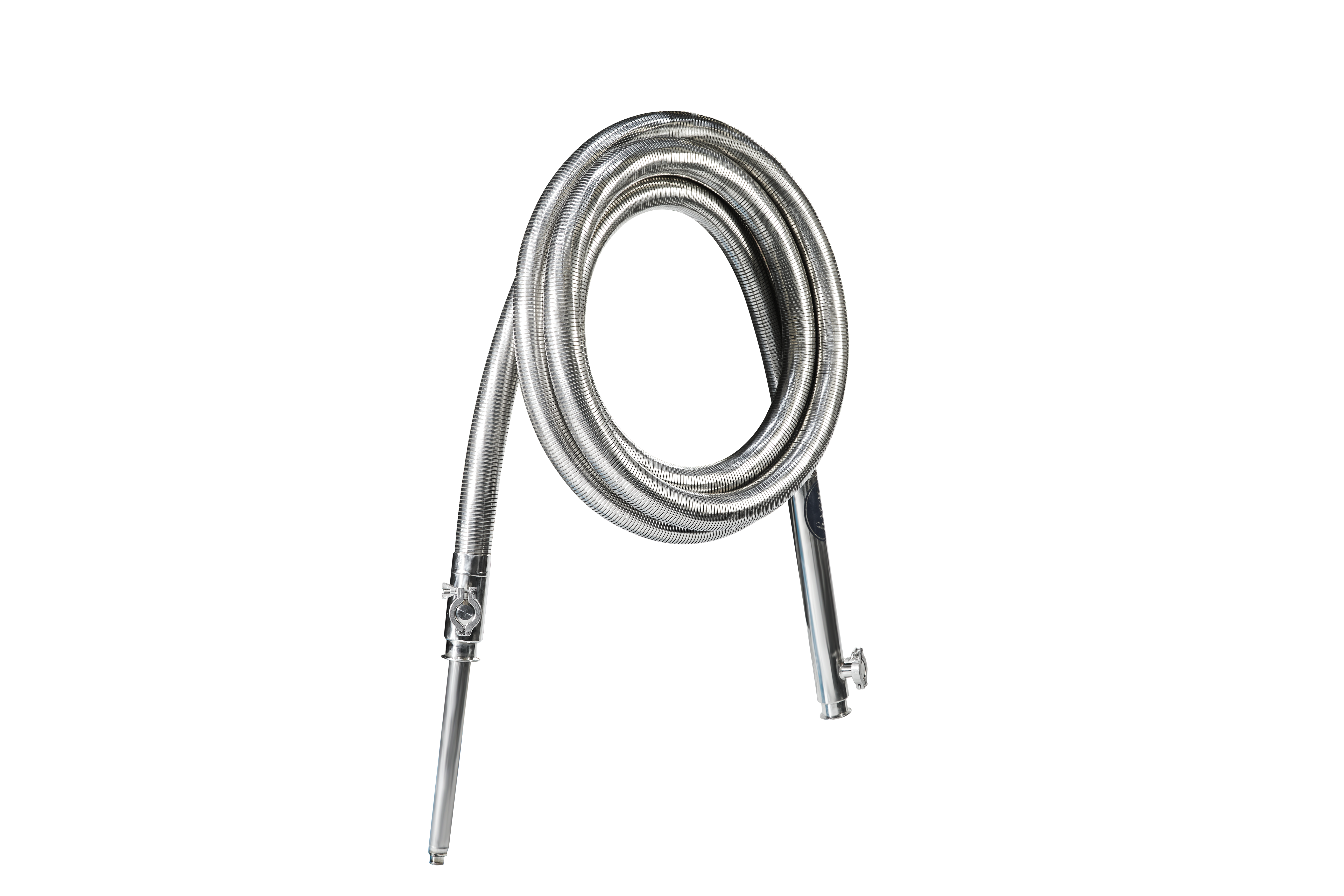
A fair cost comparison must include more than straight-pipe material. Conventional insulation may appear economical at first, but field labor for insulation, vapor barriers, cladding, repairs, supports, weather protection, and complex fittings can significantly increase installed cost. By contrast, our Vacuum Insulated Pipe is prefabricated as an engineered assembly, allowing the vacuum jacket, thermal insulation, supports, and connection interfaces to be completed under controlled factory conditions before delivery. Vacuum Insulated Flexible Hose can be used where vibration, movement, alignment tolerance, or equipment connections make rigid routing impractical, while a Vacuum Insulated Valve reduces local heat ingress around isolation or control points. A Vacuum Insulated Phase Separator may also be included where vapor accumulation, elevation changes, or two-phase flow affect liquid delivery stability. Consider a long LN2 distribution line supplying several process tools in a semiconductor plant: a conventional insulated system may meet the basic pressure requirement, yet repeated flashing at distant use points can increase venting and extend cooldown time. A better-engineered solution may combine rigid Vacuum Insulated Pipe, localized cryogenic hose sections, phase management, and carefully selected valve locations to control both thermal and hydraulic behavior.
● Where Vacuum Insulated Pipe Usually Delivers the Strongest Economic Value
The business case for vacuum insulation becomes stronger as service temperature decreases, line length increases, utilization becomes more continuous, or the process becomes more sensitive to liquid quality and pressure stability. We see this most clearly in liquid nitrogen systems, industrial gas plants, LNG infrastructure, helium service, hydrogen projects, research facilities, and semiconductor manufacturing. LNG terminals in Southeast Asia, for example, may place high value on reduced heat ingress and reliable operation over long transfer routes, while semiconductor facilities in East Asia may prioritize stable liquid delivery, cleanliness, compact routing, and predictable process conditions. Industrial gas plants in Europe often require close coordination with piping codes, NDE requirements, pressure ratings, oxygen-cleaning procedures, and project documentation. Hydrogen projects in the Middle East introduce additional challenges related to material selection, extreme temperature, joint design, and system safety. Our Mini Tank systems and related cryogenic equipment can also be integrated where localized storage or buffering is required. We manufacture according to applicable international requirements and project specifications, with ASME, CE/PED, and ISO capabilities subject to the relevant certification scope, product category, and final project requirements.

● Procurement Decisions Should Be Based on Lifecycle Cost, Not Pipe Price Alone
When we help customers compare Vacuum Insulated Pipe with conventional insulation, we recommend evaluating at least five cost categories: equipment purchase, installation labor, heat leak and product loss, maintenance exposure, and operational risk. A lower purchase price can be attractive during tendering, but it should be weighed against future insulation repair, moisture ingress, repeated cooldown, venting, process instability, access restrictions, and production downtime. Pressure requirements must also be considered early because connection type, pipe wall thickness, bayonet design, welded joints, Vacuum Insulated Valve selection, and test requirements can materially affect total cost. The most economical cryogenic transfer system is therefore the one that matches the actual operating duty rather than simply using the lowest-cost insulation technology everywhere. In some projects, conventional insulation is entirely appropriate; in others, the thermal and operational advantages of vacuum insulation justify the higher initial capital cost. At HL Cryogenics, we prefer to review the medium, flow, pressure, temperature, routing, operating profile, connection interfaces, and applicable codes before recommending a configuration. For a project-specific VIP versus conventional insulation evaluation, our engineering team can review the duty and help identify the technically and commercially appropriate solution.
● FAQS
Since 1992, HL Cryogenics has specialized in the design and manufacturing of high-vacuum insulated cryogenic piping systems and related support equipment, tailored to meet diverse customer needs. We hold ASME, CE, and ISO 9001 certifications, and have provided products and services to many well-known international enterprises. Our team is sincere, responsible, and committed to excellence in every project we undertake.
Vacuum Insulated/Jacketed Pipe
Vacuum Insulated/Jacketed Flexible Hose
Phase Separator / Vapor Vent
Vacuum Insulated (Pneumatic) Shut-off Valve
Vacuum Insulated Check Valve
Vacuum Insulated Regulating Valve
Vacuum Insulated Connectors for Cold Boxes & Containers
MBE Liquid Nitrogen Cooling Systems
Other cryogenic support equipment related to VI piping — including but not limited to safety relief valve groups, liquid level gauges, thermometers, pressure gauges, vacuum gauges, and electric control boxes.
We are happy to accommodate orders of any size — from single units to large-scale projects.
HL Cryogenics' Vacuum Insulated Pipe (VIP) is manufactured in accordance with the ASME B31.3 Pressure Piping Code as our standard.
HL Cryogenics is a specialized vacuum equipment manufacturer, sourcing all raw materials exclusively from qualified suppliers. We can procure materials that meet specific standards and requirements as requested by customers. Our typical material selection includes ASTM/ASME 300 Stainless Steel with surface treatments such as acid pickling, mechanical polishing, bright annealing, and electro polishing.
The size and design pressure of the inner pipe are determined according to the customer's requirements. The size of the outer pipe follows HL Cryogenics' standard specifications, unless otherwise specified by the customer.
Compared with conventional piping insulation, the static vacuum system provides superior thermal insulation, reducing gasification losses for customers. It is also more cost-effective than a dynamic VI system, lowering the initial investment required for projects.
● Related Posts



Post time: Oct-20-2026


