
A properly designed and maintained Vacuum Insulated Pipe can remain in service for many years, and in well-controlled applications its useful life may extend for decades. In practice, service life is governed less by the stainless-steel pipe itself than by vacuum integrity, mechanical condition, operating cycles, installation quality, and the environment around the cryogenic transfer system. At HL Cryogenics, we therefore evaluate lifetime as a system question rather than assigning one fixed number to every cryogenic pipe. The inner process pipe and outer jacket are normally manufactured from corrosion-resistant stainless steel selected according to the medium, pressure, temperature, and project standard. Between them, the evacuated annular space limits heat transfer by suppressing gas conduction, while multilayer insulation reduces thermal radiation and carefully designed supports limit solid conduction. If vacuum insulation performance remains stable and the pipe is protected from mechanical damage, thermal efficiency can remain consistent for a long operating period. For procurement teams, the important question is therefore not simply “How old is the pipe?” but “Has the vacuum, mechanical structure, and insulation system remained within acceptable condition?”

Phase Separator

Vacuum Insulated Pipe

Vacuum Insulated Flexible Hose

Vacuum Insulated Shut-off Valve
Table of Contents
1. What Determines Vacuum Insulated Pipe Lifetime?
2. Maintaining Long-Term Vacuum and Thermal Efficiency
3. Service Life Across Cryogenic Industrial Applications
4. Procurement and Maintenance Planning for Vacuum Insulated Pipe
● What Determines Vacuum Insulated Pipe Lifetime?
The main lifetime factors are vacuum stability, sealing quality, thermal cycling, corrosion exposure, vibration, and mechanical loading. Every Vacuum Insulated Pipe experiences contraction when cooled from ambient temperature to cryogenic service. In a liquid nitrogen system, for example, the inner pipe may operate near -196°C, creating substantial differential contraction relative to the outer jacket. Expansion sections, supports, offsets, flexible elements, and connection geometry must therefore be designed to accommodate repeated temperature cycles without overstressing welds or vacuum boundaries. Vacuum degradation is another important consideration. Even a very small amount of residual gas increases conductive heat transfer across the annular space, while long-term outgassing from internal surfaces can gradually affect vacuum insulation performance. We address this through controlled fabrication, cleaning, evacuation, leak testing, and the use of suitable adsorption or getter materials where required. External conditions also matter. A cryogenic pipe installed indoors in a semiconductor facility faces different risks from a line installed at an LNG terminal in Southeast Asia or an industrial gas plant exposed to weather. Correct material selection and project-specific mechanical design are therefore essential to achieving a long service life.
● Maintaining Long-Term Vacuum and Thermal Efficiency
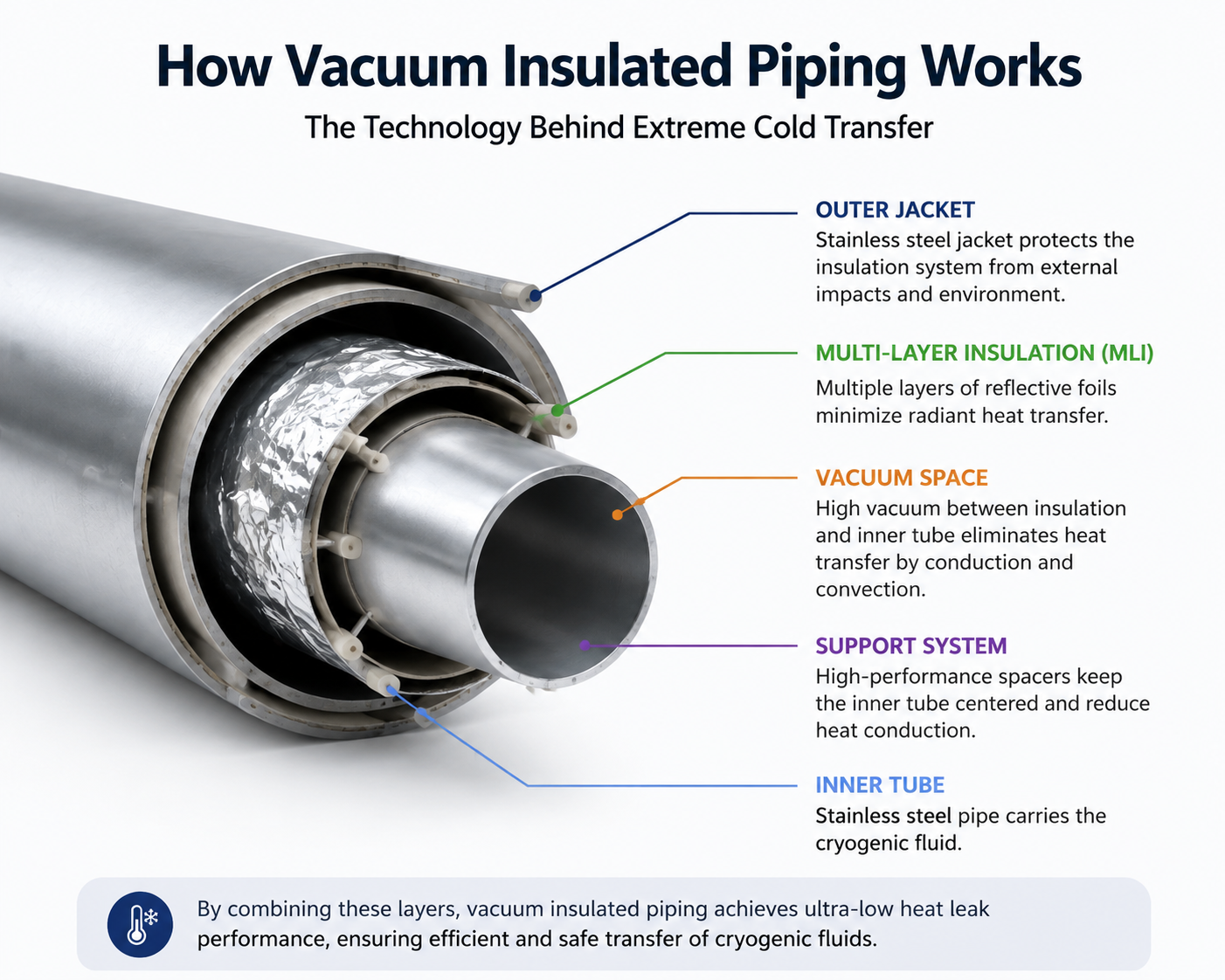
Vacuum maintenance does not necessarily mean continuous pumping. Many Vacuum Insulated Pipe systems are manufactured as sealed static-vacuum sections and are designed to retain their vacuum for long periods without permanent pumping infrastructure. For applications where higher reliability, easier maintenance, or centralized vacuum management is required, we can integrate a Dynamic Vacuum Pump System. This allows selected sections of the cryogenic transfer system to be monitored and re-evacuated when necessary, which can be useful in large installations, high-duty systems, or projects where downtime is particularly costly. Maintenance should also consider the complete system rather than the pipe alone. A Vacuum Insulated Valve must preserve both flow-control reliability and insulation continuity, while a Vacuum Insulated Flexible Hose should be inspected for excessive bending, external damage, or repeated mechanical movement. A Vacuum Insulated Phase Separator can improve liquid supply stability by separating vapor from liquid before downstream equipment, reducing unstable two-phase flow in sensitive applications. A realistic engineering scenario would be a long liquid nitrogen distribution line where outlet performance gradually becomes less stable. Instead of immediately replacing the cryogenic pipe, we would first check vacuum condition, connection integrity, valve operation, phase behavior, and any mechanical changes in the routing.
● Service Life Across Cryogenic Industrial Applications
The expected lifetime of a Vacuum Insulated Pipe also depends strongly on how the system is used. A liquid nitrogen system serving semiconductor tools in East Asia may operate almost continuously but under relatively controlled indoor conditions. LNG infrastructure may involve larger diameters, outdoor exposure, longer routing, and more significant thermal and mechanical loads. Hydrogen projects in the Middle East may impose different material, cleanliness, safety, and certification requirements, while industrial gas applications in Europe often require close integration with plant standards and pressure-equipment regulations. These differences affect inspection intervals and maintenance strategy. Pressure requirements are especially important because the process pipe, connections, valves, and associated components must be designed for both operating and design pressure, not simply cryogenic temperature. At HL Cryogenics, we can manufacture systems in accordance with applicable ASME, CE/PED, ISO, and project-specific requirements, subject to the certification scope and the final technical specification. We also consider how components such as a Vacuum Insulated Flexible Hose, Vacuum Insulated Valve, Vacuum Insulated Phase Separator, or Mini Tank interact with the main cryogenic pipe. Good system integration reduces unnecessary thermal bridges, poorly supported sections, and maintenance points that can shorten effective service life.
Procurement and Maintenance Planning for Vacuum Insulated Pipe
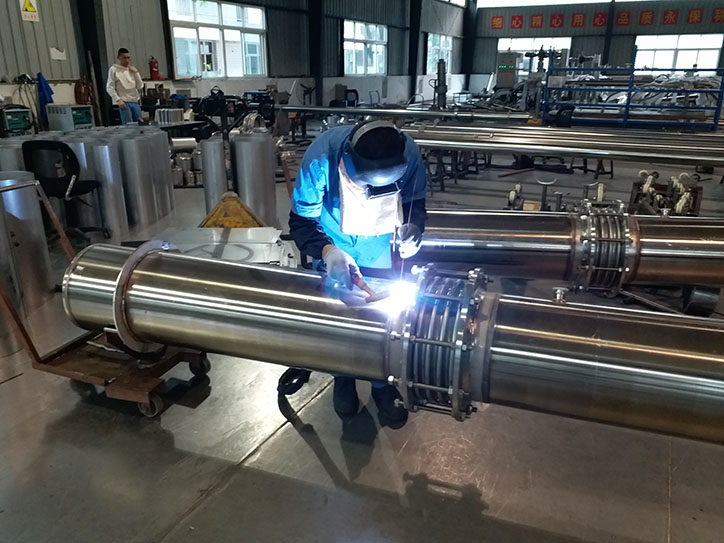
For procurement teams, lifecycle cost is usually more meaningful than purchase price alone. A lower-cost cryogenic pipe may become expensive if vacuum performance deteriorates early, joints require frequent intervention, or the system produces excessive heat leak and unstable liquid delivery. We recommend evaluating material grade, weld quality, vacuum design, connection type, support arrangement, expected thermal cycles, inspection access, maintainability, and available vacuum recovery strategy before placing an order. It is also useful to define what maintenance means for the specific project. In many installations, routine work may be limited to visual inspection, checking supports and connections, monitoring thermal behavior, and confirming that no section shows abnormal frosting or performance loss. Systems equipped with a Dynamic Vacuum Pump System can add another level of vacuum management where the project justifies it. Properly designed Vacuum Insulated Pipe should not be treated as a consumable item that requires frequent replacement; it should be engineered as long-life cryogenic infrastructure. At HL Cryogenics, we review each application according to operating temperature, pressure, medium, routing, environment, and maintenance philosophy. For new projects or existing cryogenic transfer systems, our engineering team can help assess the most appropriate configuration and long-term maintenance approach.
● FAQS
Since 1992, HL Cryogenics has specialized in the design and manufacturing of high-vacuum insulated cryogenic piping systems and related support equipment, tailored to meet diverse customer needs. We hold ASME, CE, and ISO 9001 certifications, and have provided products and services to many well-known international enterprises. Our team is sincere, responsible, and committed to excellence in every project we undertake.
Vacuum Insulated/Jacketed Pipe
Vacuum Insulated/Jacketed Flexible Hose
Phase Separator / Vapor Vent
Vacuum Insulated (Pneumatic) Shut-off Valve
Vacuum Insulated Check Valve
Vacuum Insulated Regulating Valve
Vacuum Insulated Connectors for Cold Boxes & Containers
MBE Liquid Nitrogen Cooling Systems
Other cryogenic support equipment related to VI piping — including but not limited to safety relief valve groups, liquid level gauges, thermometers, pressure gauges, vacuum gauges, and electric control boxes.
We are happy to accommodate orders of any size — from single units to large-scale projects.
HL Cryogenics' Vacuum Insulated Pipe (VIP) is manufactured in accordance with the ASME B31.3 Pressure Piping Code as our standard.
HL Cryogenics is a specialized vacuum equipment manufacturer, sourcing all raw materials exclusively from qualified suppliers. We can procure materials that meet specific standards and requirements as requested by customers. Our typical material selection includes ASTM/ASME 300 Stainless Steel with surface treatments such as acid pickling, mechanical polishing, bright annealing, and electro polishing.
The size and design pressure of the inner pipe are determined according to the customer's requirements. The size of the outer pipe follows HL Cryogenics' standard specifications, unless otherwise specified by the customer.
Compared with conventional piping insulation, the static vacuum system provides superior thermal insulation, reducing gasification losses for customers. It is also more cost-effective than a dynamic VI system, lowering the initial investment required for projects.
● Related Posts



Post time: Nov-06-2026


