
The right design pressure for liquid nitrogen transfer lines is usually between PN16 and PN40 (about 1.6 to 4.0 MPa), but this can change based on the system setup, the conditions under which it runs, and safety margins. To ensure safety and long-term reliability, we choose a design pressure that is 1.5 to 2 times higher than the maximum operating pressure for most industrial uses, as required by ASME B31.3 or EN 13480.
In cryogenic engineering, figuring out the right design pressure isn't just a matter of following the rules; it also affects the safety, thermal performance, and lifecycle cost of the system. We think of design pressure at HL Cryogenics as a decision that takes into account a lot of different factors, such as fluid properties, pressure changes, and how the system will be used.
Liquid nitrogen systems typically operate at low to moderate pressures (0.2–1.6 MPa). However, transient conditions such as pump startup, valve closure, or vaporization events can generate pressure spikes. This is why we never design based solely on nominal operating pressure; instead, we incorporate dynamic system behavior into our calculations.

Table of Contents
1. Key Factors Influencing Design Pressure
2. Typical Design Pressure Ranges
3. System Components That Influence Pressure Design
4. Applications Across Industries and Regions
● Key Factors Influencing Design Pressure
1. Transients and Operating Pressure
The baseline is the highest pressure that is expected to be used. But we also need to think about:
Pressure at the pump's discharge
During quick valve operation, pressure rises.
Thermal expansion in closed areas
In a well-designed cryogenic transfer system, these things can raise the internal pressure by 30% to 50% above steady-state conditions.
2. Heat Leak Control and Vacuum Insulation
A Vacuum Insulated Pipe keeps heat from getting in, which cuts down on nitrogen boil-off. But even small heat leaks can cause localized vaporization, which raises the pressure inside the system.
This is why the performance of vacuum insulation is directly related to pressure stability. Our systems at HL Cryogenics are made to keep heat leaks to a minimum, which keeps pressure changes within predictable ranges.
3. Material Selection and Structural Integrity
The selection of stainless steels such as SS304 or SS316 is critical for cryogenic pipe systems. These materials maintain mechanical strength at low temperatures and comply with ASME and EN standards.
Design pressure must align with:
- Allowable stress values at cryogenic temperatures
- Wall thickness calculations per code
- Long-term fatigue resistance
● Typical Design Pressure Ranges and Role of Vacuum Technology in Pressure Stability
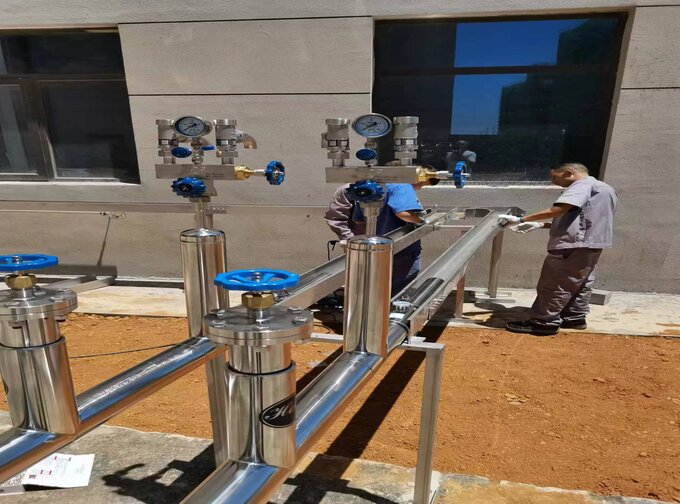
By combining our Dynamic Vacuum Pump System, Vacuum Insulated Valve, and Phase Separator, we give you a setup that moves liquid helium efficiently and keeps costs down. Our Mini Tanks and Flexible Hoses let us handle both mobile and fixed jobs with precision.
From our work on industrial gas projects, we usually suggest:
PN16–PN25 for small-scale systems (Mini Tank supply)
Standard industrial distribution: PN25 to PN40
PN40 and higher are for high-performance or long-distance systems.
A Vacuum Insulated Flexible Hose is often rated the same as a flexible connection, but it also has to be able to handle mechanical stress and movement, which can change safety margins.
The integration of a Dynamic Vacuum Pump System is a major difference between modern systems. This technology keeps the vacuum level in the annular space of a cryogenic pipe or hose at a certain level.
Without regular vacuum maintenance, insulation performance gets worse over time because of
Outgassing
Micro-leaks
Permeation
Our Dynamic Vacuum Pump System ensures:
- Stable vacuum levels over years of operation
- Consistent thermal performance
- Reduced risk of pressure build-up due to heat ingress
This directly contributes to lower design pressure requirements and improved safety margins.
●System Components That Influence Pressure Design
Valve with Vacuum Insulation
A Vacuum Insulated Valve is very important for controlling flow and keeping heat from leaking out. Bad valve design can make thermal bridges, which can cause localized vaporization and pressure spikes.
We design valves to:
Keep the vacuum going
Lower heat losses
Make sure the flow control works smoothly without causing pressure shocks.
Phase Separator with Vacuum Insulation
Two-phase flow is a big problem in any liquid nitrogen system. A vacuum-insulated phase separator makes sure that only liquid gets to the end user and that vapor is safely kept separate.
This stops:
Unstable flow Pressure changes Inaccurate measurements
By keeping the phase stable, we keep the system's pressure and performance steady.

● A Real-Life Engineering Situation
We used Vacuum Insulated Pipe technology to design a liquid nitrogen transfer system that spans more than 500 meters for a recent semiconductor facility project in East Asia.
The first specifications from the client said that the design pressure should be PN16. But after looking at:
Features of the pump
Quick cycling of the valve
Long length of the pipeline
We suggested that you upgrade to PN25. This change stopped possible pressure spikes during peak operation and made sure that the company followed ISO and SEMI standards.
The result was:
No failures due to pressure
More stable processes
Less nitrogen use because of better insulation
● FAQS
Since 1992, HL Cryogenics has specialized in the design and manufacturing of high-vacuum insulated cryogenic piping systems and related support equipment, tailored to meet diverse customer needs. We hold ASME, CE, and ISO 9001 certifications, and have provided products and services to many well-known international enterprises. Our team is sincere, responsible, and committed to excellence in every project we undertake.
Vacuum Insulated/Jacketed Pipe
Vacuum Insulated/Jacketed Flexible Hose
Phase Separator / Vapor Vent
Vacuum Insulated (Pneumatic) Shut-off Valve
Vacuum Insulated Check Valve
Vacuum Insulated Regulating Valve
Vacuum Insulated Connectors for Cold Boxes & Containers
MBE Liquid Nitrogen Cooling Systems
Other cryogenic support equipment related to VI piping — including but not limited to safety relief valve groups, liquid level gauges, thermometers, pressure gauges, vacuum gauges, and electric control boxes.
We are happy to accommodate orders of any size — from single units to large-scale projects.
HL Cryogenics' Vacuum Insulated Pipe (VIP) is manufactured in accordance with the ASME B31.3 Pressure Piping Code as our standard.
HL Cryogenics is a specialized vacuum equipment manufacturer, sourcing all raw materials exclusively from qualified suppliers. We can procure materials that meet specific standards and requirements as requested by customers. Our typical material selection includes ASTM/ASME 300 Series Stainless Steel with surface treatments such as acid pickling, mechanical polishing, bright annealing, and electro polishing.
The size and design pressure of the inner pipe are determined according to the customer's requirements. The size of the outer pipe follows HL Cryogenics' standard specifications, unless otherwise specified by the customer.
Compared with conventional piping insulation, the static vacuum system provides superior thermal insulation, reducing gasification losses for customers. It is also more cost-effective than a dynamic VI system, lowering the initial investment required for projects.
● Related Posts



Post time: Apr-22-2026


