
In cryogenic transfer systems, the initial purchase cost is only one part of the equation. For short and simple installations, conventional insulation can still be a practical solution. However, in continuous industrial operation, especially for LNG, liquid nitrogen, argon, or hydrogen service, operating losses and maintenance requirements usually become more important than the original equipment cost.
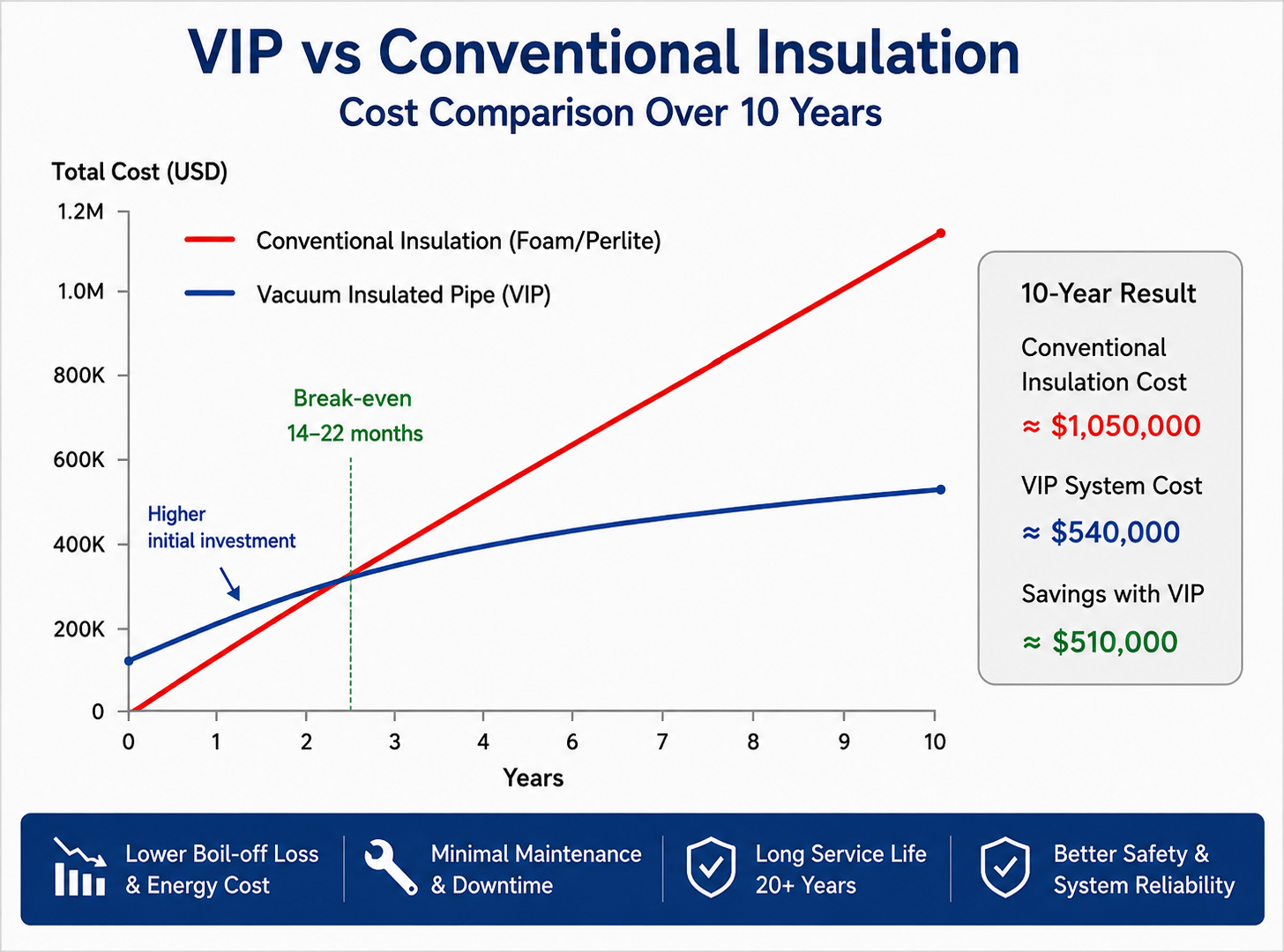
Based on field applications we have seen over the years, vacuum insulated systems generally recover the higher upfront investment within roughly 1.5 to 2 years, depending on operating conditions, product value, and pipe length.
Why conventional insulation performance changes over time
Conventional cryogenic insulation materials such as polyurethane foam, cellular glass, or perlite can provide acceptable thermal performance when new. Typical thermal conductivity is often in the range of 0.015–0.030 W/m·K under ideal conditions.
The challenge is that cryogenic systems rarely operate under ideal conditions for long periods.
In humid environments, moisture ingress is difficult to avoid completely. Perlite may settle over time, and foam insulation can suffer from aging, compression, or mechanical damage during operation and maintenance. In some applications, thermal performance deteriorates significantly after several years of service.
For liquid nitrogen or LNG transfer lines, even a relatively small increase in heat leak can noticeably increase vapor generation. Over long transfer distances, this directly affects product loss and system efficiency.
Maintenance is another factor that is sometimes underestimated during the procurement stage. Once insulation becomes saturated or damaged, repair work is often labor intensive, especially for outdoor installations or pipe racks in operating facilities.
Thermal performance advantages of vacuum insulation
Vacuum insulated piping operates on a different principle. By evacuating the annular space to a high vacuum level, gaseous conduction and convection are reduced to very low levels. Radiation becomes the primary remaining heat transfer mechanism, which is minimized through multilayer insulation design.
Under stable vacuum conditions, effective thermal conductivity can typically remain in the range of approximately 0.0005–0.002 W/m·K, depending on system configuration and operating temperature.
In practice, this reduction in heat leak can have a measurable impact on boil-off losses. For example, in one industrial gas application involving liquid argon transfer, boil-off was reduced substantially after replacing conventional insulated piping with a vacuum insulated system. The exact savings naturally depend on flow rate, duty cycle, ambient conditions, and transfer distance.
Long-term vacuum stability matters
One important point that is often overlooked is that vacuum quality itself must remain stable over time.
Static vacuum systems may gradually experience performance reduction due to outgassing, seal permeation, or small leakage rates accumulated over many years of operation. The effect is usually slow, but in long-term continuous service it becomes relevant.
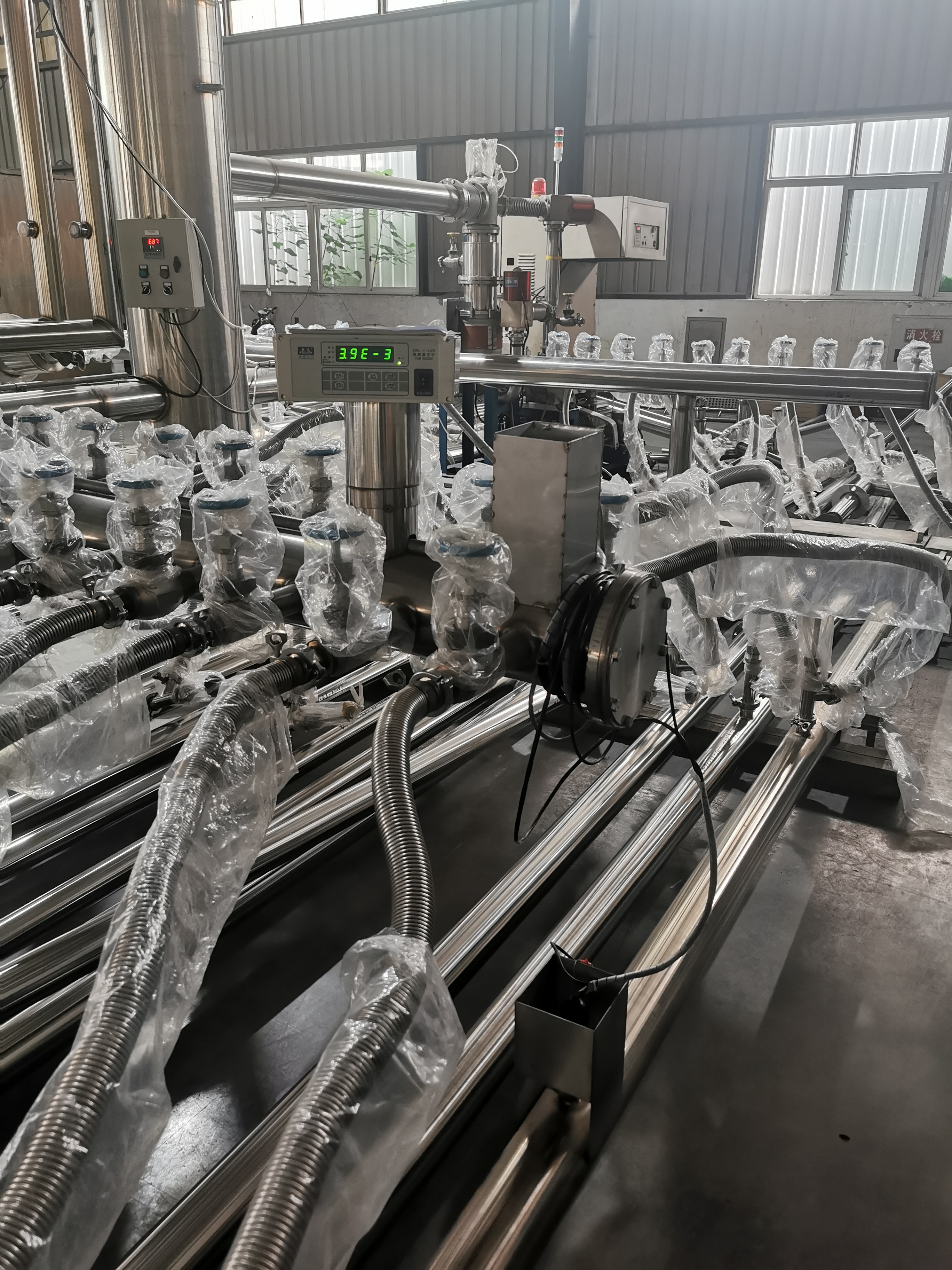
To address this, our system can be equipped with a Dynamic Vacuum Pump System, which periodically removes non-condensable gases from the annular space and helps maintain vacuum performance during operation.
This approach is particularly useful for large LNG infrastructure, semiconductor facilities, and applications with continuous duty cycles where long-term thermal stability is critical.
In one semiconductor facility in Asia, the vacuum level remained below 5×10⁻⁵ mbar after several years of operation with periodic vacuum maintenance. Under similar service conditions, some conventional static vacuum systems may eventually require factory re-evacuation.
Components beyond the pipe itself
The performance of a cryogenic transfer system is not determined only by the straight pipe section.
Valves, flexible connections, phase separators, and other components can also become significant sources of heat ingress if they are not properly insulated.
For example, conventional cryogenic valve stems can create localized thermal bridges. Vacuum jacketed valve designs help reduce this effect considerably and improve overall thermal efficiency of the system.
Phase separators are also important in applications where vapor formation affects downstream equipment stability. In hydrogen and LNG systems, maintaining stable liquid delivery can help reduce operational fluctuation and extend maintenance intervals for sensitive components.
In distributed industrial gas systems, flexible vacuum insulated hoses combined with small vacuum insulated storage tanks can also simplify installation compared with fully rigid piping layouts, particularly where space constraints or equipment movement are involved.
Example from a humid LNG installation
A project in Southeast Asia involved LNG transfer piping installed near truck loading bays in a high-humidity coastal environment. The original system used foam-insulated piping.
Over time, repeated moisture exposure caused insulation degradation and recurring maintenance work. According to the operator, insulation replacement and associated labor represented a significant recurring cost during plant operation.
The system was later upgraded to vacuum insulated piping and flexible vacuum insulated hose assemblies connected to a centralized vacuum maintenance system.
After the upgrade, insulation-related maintenance requirements were reduced substantially, and operational continuity improved. Although the vacuum insulated system required higher initial investment, the operator estimated that long-term operating and maintenance costs were noticeably lower over the projected service period.
Evaluating total cost instead of purchase price alone
For procurement teams, evaluating only the day-one equipment cost can sometimes give an incomplete picture of overall system economics.
In many continuous cryogenic applications, cumulative heat leak over years of operation has a direct energy and product cost impact. The difference becomes more visible as transfer distance and operating hours increase.
Our systems are designed in accordance with ASME B31.3 and EN 13458 requirements. Vacuum insulated pipe sections are available in 304 and 316L stainless steel configurations, with expansion compensation designed for repeated thermal cycling. Flexible hose assemblies can also be configured for higher working pressure applications depending on project requirements.
Actual performance and return on investment will vary from project to project, which is why thermal analysis should ideally be based on real operating conditions rather than simplified assumptions.
When conventional insulation may still be suitable
Conventional insulation is still a reasonable option in certain situations.
For very short pipe runs, temporary installations, or intermittent operation with low annual utilization, the additional cost of vacuum insulation may not always be justified economically.
However, for permanent infrastructure with continuous or high-duty cryogenic service, vacuum insulated systems are often more advantageous when evaluated over the full operating lifecycle.
Post time: May-15-2026


